
The Role of Muscles in Pole Fitness
Maze Prince | SEP 9, 2026
Growing Muscles in Pole

Pole Muscles in extension The Core- Push pull. Full body Growth is possible!
Source: kjpargeter - Magnific.com
Reprinted/edited from former website:magepoleflow.com
3-5 min read
Pole Fitness Grows muscles
Here is an indepth review of science and actual use of muscles in pole fitness. Super geeky and researched for WOMEN ages late 20's to 90s. Pole is amazing at giving you the body you KNEW was in there but couldn't find a way to get to!
Pole fitness—also known as pole dance, pole sport, aerial pole, or pylon yoga—has gained serious scientific attention as a dynamic, engaging exercise that combines dance, gymnastics, and strength training. Major sports physiology and kinesiology universities around the world have studied it extensively since 2022, and the feedback is overwhelmingly positive. From beginners and amateur recreational dancers to professional health providers and researchers, the data points to significant MUSCLE MASS GROWTH.
Because it’s a full-body workout—and insanely fun—it’s super easy to stick with while spending less time "working out."
You're having so much fun you don't even feel like you're exercising, but your body starts responding quickly whether you do your homework or not! Pole fitness requires a unique blend of muscle engagement, flexibility, and coordination. This article explores how your muscles work in pole fitness and how they contribute to overall performance and health benefits.
Key Muscle Groups Involved
 The Pelvic complex
Sources: Kenhub 2026
Core Pelvis Muscles - Pole's lifeline muscles.
1. Iliopsoas & Lower Spinal Erectors: This is your center of gravity, supporting healthy pelvic blood flow and helping you lift your knees to your chest. This muscle group is arguably the most important one a woman has for everyday life—it helps you walk, keeps you balanced, and supports your internal organs!
There are two sets of psoas muscles in humans, though oddly enough, about 40% of women only have one set. Training them safely builds foundational strength for all your dance moves. Polers rarely keep their legs at a simple straight angle, and when the legs do extend, the glute complex works to elongate the area. Training these pelvic muscle groups spills right over into your hip extenders (Donnelly et al., 2026)!
Some women have psoas muscles that are too tight to engage properly. Women over 35 often begin to lose muscle thickness here, though they might not notice symptoms (like back pain or bladder issues from hormonal changes) for another 15 years. That’s why training these muscles is crucial for long-term female health! In fact, when researchers study hormone optimization, this is the very first muscle complex they check to measure improvements in strength and mobility (Canosa-Carro et al., 2026; Tapper et al., 2019).
Every move in pole depends on these muscles working in a push-pull balance. As they strengthen, they keep your muscles and bones aligned, making walking and bending feel effortless. We tend to lose this density during perimenopause, making pole fitness a fantastic way to protect your long-term vitality (Canosa-Carro et al., 2026; Donnelly et al., 2026; Iñigo-Vollmer et al., 2023). Honestly, there just isn't anything better for actual muscle growth than aerial pole fitness!
2. Hip Extenders: There are at least six major muscles in this group. You need to train them so your legs can clamp onto the pole, allowing you to transition dynamically between moves using inner-thigh contact. They are also essential for controlled, wide-leg dance positions.
We use these muscles from day one—going up the pole, holding poses, and working on the floor. Some consider them "hip" muscles while others call them "leg" muscles, but they are closely connected to the iliopsoas and are relatively small compared to other major groups. Sitting for long periods (even just four months!) can change how these muscles perform. Excellent conditioning is key so they grow safely without overstretching. It’s not just about raw strength; it’s about building endurance in these smaller stabilizing muscles (Donnelly et al., 2026; Rerung, 2026).
Upper Body Muscles: Your GRIP muscles for LONGEVITY
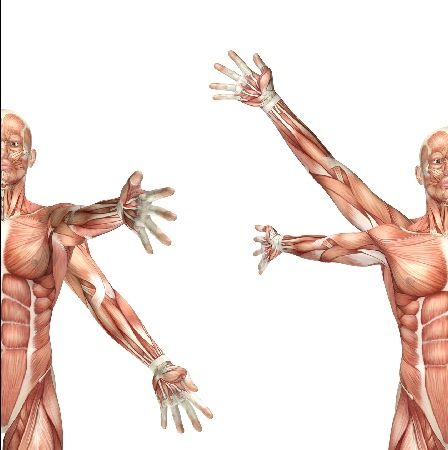 Shoulder Chest & arms muscles
Source: kjpargeter - Magnific.com
Grip is not just your hands. Grip is the full complex of hands, arms chest back...well everything!
3. Shoulders: The deltoids work hard during pole fitness, especially during moves where you lift your body off the ground or support your weight with your arms. Proper engagement happens naturally as these muscles grow! When starting out, it's easy to dance on the pole rather than with it, so we need to pay careful attention to alignment so larger muscle groups don't try to cheat the movement (de la Torre Garrote, 2025).
4. Arms: The biceps and triceps handle the pushing and pulling motions that power your grips and spins. Eccentric contractions—where the muscle lengthens while under tension—challenge and build these areas both on the pole and on the floor. Think of lowering a weight super slowly in the gym; in pole, we call those "negatives" or conditioning regressions!
5. Forearms: Strong forearms give you the firm grip needed to execute moves safely. The hands, forearms, arms, and shoulders build what's called "dynamic grip"—grip strength in motion! Tests show that the grip strength developed by polers matches that of professional tennis players, golfers, and gymnasts (Rantanen, 2026; Kouaho & Epstein, 2026; Goluchowska, 2026; Ignatoglou, 2024; Kostrikova, 2025). Safe curriculum training ensures these areas keep growing over time (de la Torre Garrote, 2025).
A Note on Shoulder Health: Most pre-2020 pole research focused on injury prevention in professional pole dancers and trainers. While it might look like "pole is bad for shoulders," that’s not what the data actually says! Researchers found that the biggest factor was simply the number of hours spent on the pole—professionals often train or teach 4 to 6 hours a day. The real preventative strategy is correct engagement and taking proper rest days, not avoiding pole altogether. Another factor is over-training out of frustration when trying to force a new move (Goluchowska et al., 2022; Kouaho & Epstein, 2026; Ignatoglou, 2024; de la Torre Garrote, 2025).
Central-trunk Muscles
 There are 5 muscle groups in the Abd group
Source: kjpargeter - Magnific.com
6. Abdominals: Core strength is vital for stability and control. Many people assume "core" just means a beach belly, but it's much more than that! The rectus abdominis, obliques, and transverse abdominis all work together to help you balance, spin, invert, and transition smoothly.
For polers, core isn't just about a six-pack. It's common for new polers to see muscle definition around month three just from posture corrections and overall growth! Interestingly, the pyramidalis muscle—located deep in the lower abdomen near the pelvis—is actually missing in about 20% of humans. It’s not a big deal, but it’s a fun fact!
The obliques aren't specifically targeted in every sport, but gymnastics, martial arts, and pole dance rely on them for dynamic rotational force. Bodybuilders often skip heavy oblique work to keep a narrow waistline, and these muscles can be relatively weak in most women—unless you have toddlers, since you use your obliques to quickly twist and scoop up a kid! (Kostrikova, 2025; Cinti et al., 2024).
In pole, moving your upper and lower body in opposing directions creates bilateral definition long before a six-pack shows up (Donnelly et al., 2026).

Source: kjpargeter - Magnific.com
7. Back Muscles:
The latissimus dorsi and erector spinae support movements that require pulling the body up or arching the back during poses. The spinal erectors run along the spine interlacing with multiple smaller groups by region from the neck to the ribs, to the mid-back to, the pelvis region.
As polers use the push-pull counterbalance, both in learning mode & performing mode, as well as, on the floor and going up onto the pole... these 14 muscles grow, sometimes for the first time ever in a women's lifespan. The results are better balance as well as strength. Breasts lift upwards, shoulders DROP and the head rises in posture and... so does confidence! Women are NOT mini men we carry a weight on the back in more than just metaphor!
The PUSH PULL of this area can be trained in the gym.... however, the entire tiny back muscles can not, except in gymnasits and pole aerialists as in progressive lifting training, which is pretty cool. (Kostrikova, K. (2025), Kostrikova, et al. 2025) Women view the back as 'too thin", "too wide" or cringe worthy, because of neck bumps, bra bulges, "back rolls" but in pole... things correct fairly quickly. The "lumps" tend to decrease in this area as the smaller muscles are grown underneath!. We have never been TAUGHT we have more than 2 muscles back there...did you know you have FOURTEEN back muscles there?!!!?
Yep They are in layers called: primary (the usual gym muscles), extrinsic (those involved in breathing in and out), the Intrinsic group (know as the true muscles which allow you to twist and turn), the trans-spinals and, the deep segmentals (deepest layers). The back in pole, is a fascinating story for many dancers, and we have photos and science data examples/statistics coming in a blog soon, so stay tunes (go get on that mailing list!)
Lower Body Muscles

Pole Trains the Back SIDE ! Honest!
Source: kjpargeter - Magnific.com
8 & 9.Quadriceps and Hamstrings:
These muscles assist in controlling leg movements and are often engaged during climbs and inverting maneuvers. Toepoints, knees bent front and behind, require HOLDING those muscle tight for a full 60 minutes almost- pure growth! The squatting and getting up from the pole are constant & hit these areas hard. When in the air it feels like the quads are contracting however, GRAVITY is actually requiring the HAMSTRINGS to work overtime to keep the legs up in the air and allow you to not topple over backwards! SO YES!!!! Polers DO work the full leg. In 60 minutes, often to failure if the class you take is a choreography/trick class. The conditioning exercises focus on elongations of the groups and often Glute bridges of various torturous leg positions that one might get on the pole to do later. Beginners notice the defining leg muscle line at the side of the leg second (after the abdominal oblique lines)
10 .Glutes: YOUR POWER IS IN YOUR FANNY!!!!
Strong glute muscles generate the pelvic thrust that locks in almost every pole move—whether you're inverted, upside down, or sideways. The gluteal complex actually includes 9 distinct muscles working together (the major glutes, deep lateral rotators, and stabilizing hip muscles) to counterbalance your pelvis and core.
They get attention in every single class. From walking stability and pole posture to providing power for dynamic kicks and locking your body into position (like in a pole climb, Gemini, or Jade split), these muscles hyper-contract in opposition to the iliopsoas during intense isometric squeezes to control your spins and hold rigid poses.
11. Calves: Gorgeous pointed toes and rock-solid spin balance? Thank your calves! Your foot-to-floor stability starts growing the second you step into class in socked feet. But when you transition from basic toe-points to reining in your ankles in seven-inch heels, your lower legs level up fast. The non-stop isometric holding builds sleek, strong muscle fibers that typical gym routines just can't touch!
The Takeaway
All in all, pole fitness engages all 620 total muscles in your body at once! That is why aerialists build strong, hard bodies and rarely worry about body fat—body recomposition (swapping fat for lean muscle) is a natural side effect of the sport.
As your perception shifts from what your body looks like to what it can do, the real magic happens. Gymnasts and aerialists are among the healthiest, most resilient athletes out there (Altulea et al., 2025; Rantanen et al., 2012; Kostrikova, 2025).
The real magic happens as long as you stick with it: your perspective naturally shifts from how your body looks to what it can actually do (Altulea et al., 2025). Forget what mainstream fitness has sold you: research shows gymnasts live up to eight years longer than other athletes! Because pole shares that same elite athletic foundation, you get access to those exact same incredible longevity benefits (Rantanen et al., 2012; Kostrikova, 2025).
Sure, it takes persistence, but the absolute best parts of pole fitness are:
It’s made for empowering women—even though its historical roots started as a male sport.
It’s ridiculously fun—and once you find your studio tribe, you’ll never want to quit!
So what are you waiting for? Step into a studio, find your tribe, and unlock the strong woman inside you who's ready to lift off the weight of the world. It truly works!
REFERENCE LIST
Go read some cool stuff on Google scholar!
Donnelly, G. M., Bassini, E., Casey, E., Christopher, S. M., Giagio, S., Leupold, O., ... & Solomon, W. B. (2026). Sports specific considerations for load capacity of the pelvic floor. In Sports Medicine and the Pelvic Floor (pp. 433-462). Academic Press.
Canosa-Carro, L., Nieves-Martín, M., & Rodríguez-Longobardo, C. (2026). Pelvic floor, hormones, and performance: trying to fill in the gap. Gynecology and Pelvic Medicine, 9, 1.
Tapper J, Huang G, Pencina KM, Li Z, Arver S, Martling A, Blomqvist L, Buchli C, Travison TG, Storer TW, Bhasin S, Basaria S. The effects of testosterone administration on muscle areas of the trunk and pelvic floor in hysterectomized women with low testosterone levels: proof-of-concept study. Menopause. 2019 Dec;26(12):1405-1414. doi: 10.1097/GME.0000000000001410. PMID: 31479032; PMCID: PMC6893124.
Iñigo-Vollmer, M. M. R., & Fernandez-del-Valle, M. (2023). for Optimal Performance of Active Females Throughout the Lifespan Including Children, Adolescents, and the Aging Female. The Active Female: Health Issues throughout the Lifespan, 451.
de la Torre Garrote, A. (2025).
Altulea, A., Rutten, M. G., Verdijk, L. B., & Demaria, M. (2025). Sport and longevity: an observational study of international athletes. GeroScience, 47(2), 1397-1409.
Cinti, D. T. R., Teixeira, J. C., Junior, J. D. N., Fidale, T. M., Silva, R. P. M., & Lizardo, F. B. (2024). Electromyographic analysis of core muscle activity during pole dance movements using the knee lock. Journal of Physical Education and Sport, 24(6), 1542-1550.
Goluchowska AM, Humka MI. Types of the locomotor system injuries and frequency of occurrence in women pole dancers. J Sports Med Phys Fitness. 2022;62(5):661-6. DOI: 10.23736/S0022-4707.21.12239-X. PMID: 34132513.
Rantanen, T., Masaki, K., He, Q. et al. Midlife muscle strength and human longevity up to age 100 years: a 44-year prospective study among a decedent cohort. AGE 34, 563–570 (2012). https://doi.org/10.1007/s11357-011-9256-y
Kouaho, W. J., & Epstein, D. A. (2026, April). Unpacking How Pole Dancers Come to Experience the Use of Fitness Trackers. In Proceedings of the 2026 CHI Conference on Human Factors in Computing Systems (pp. 1-16).
Ignatoglou D, Paliouras A, Paraskevopoulos E, Strimpakos N, Bilika P, Papandreou M, Kapreli E. Pole Dancing-Specific Muscle Strength: Development and Reliability of a Novel Assessment Protocol. Methods and Protocols. 2024; 7(3):44. https://doi.org/10.3390/mps7030044
Kostrikova, K. (2025). Biomechanical and kinetic aspects of acrobatic elements in pole sport. Bulletin of the National University "Chernihiv Collegium" named after T. G. Shevchenko, 187(31), 46-51.
Kostrikova, K., A., Pawelak, Z., & Mynarski, A. (2024). Longitudinal Effects of Pole Dance Training on Body Composition and Muscular Strength in Women. DOI:10.21203/rs.3.rs-3990731/v1
Jones, H., Pialgata, S. (2026). Pole Dance. In: Jones, H., Lukaszenko, A. (eds) Injury Prevention and Care in Artistic Sports. Springer, Cham. https://doi.org/10.1007/978-3-032-18105-3_10
Maze Prince | SEP 9, 2026
Share this blog post



© 2026 Mage Flow Pole & Fitness LLC