
Confessions of a Dizzy Pole Dancer: Finding Your Magic Focus Point (So You Don’t Puke)
Maze | OCT 9, 2026
Confessions of a Dizzy Pole Dancer:
Finding Your Magic Focus Point (So You Don’t Puke)

You can even be in a low-flow or floorwork class where you finally, effortlessly get into a candlestick-pike to shoulder roll, make a smooth transition to a Russian slam, and when you land you are mentally blank and blind—with absolutely no idea where you are in the room or what the next move is supposed to be!
We’ve all been there. You nail a gorgeous shape, the momentum takes over, you start cooking at Mach 3, and suddenly the studio mirrors melt into a terrifying smoothie of colors—and you hear the instructor yelling cues and your brain registers it like Charlie Brown's teacher. You slide down the pole like a sad, defeated slug, staring at the floor, waiting for the room to finish doing the Macarena.
Good news: you are not broken! Your brain is just throwing a temper tantrum due to biological, mechanical, and cardiovascular data conflicts. There is actual, hardcore clinical science behind why our bodies react this way to rotational velocity.
As with all fitness, vertigo, dizziness and lightheadedness need to be reported to your doctor especially if you have a history of fainting or falling! So read on to see if you might need a quick visit discussion or check over. I have had a Cardiologist since 2009 due to hormones due to POTS.
While I will continue researching that topic and it is known that imbalance DOES cause vertigo, inner ear changes, POTS, blood pressure irregularities and fatigue, sadl...y those are not easily found in women's research, as it relates to pole specifically. Some of what I found did discuss ballarina techniques but it truely is not related as we have centrifugal force and gravity to deal with on our systems, but I did find THAT one - keep reading!
The Basics of Dizzy
When you spin on a pole, the dizziness you feel is a direct result of how your vestibular system (the balance center located in your inner ear) interacts with your eyes, your cardiovascular system, and your brain:
The Fluid Shift:
Your inner ear contains fluid-filled structures called semicircular canals. When you spin, this fluid sloshes around, bending tiny hair cells that send motion signals to your brain. A large majority of people have one ear more sensitive than THE OTHER which can make things worse (Rabbitt, 2019).
The Sensory Mismatch:
When you finish spinning—or when your eyes try to focus on a fixed point while your body is rotating rapidly—your brain receives conflicting signals. Your eyes might see a stationary room, but the fluid in your inner ears is still moving due to inertia, making your brain believe you are still spinning. This sensory mismatch triggers motion sickness and vertigo (Johns & Lawrence, 2024).
The Blood Pressure Drop:
Beyond the inner ear fluid, rapid spinning forces a massive shift in your blood circulation. Centrifugal force pushes blood away from your chest and head toward your lower extremities. To maintain steady cerebral blood flow, your body relies on your autonomic nervous system to squeeze your blood vessels and adjust your heart rate. This takes TIME to train. If you missed last weeks article about Pole and Heart health PLEASE go find it(Bro-science article)! It gives the duration of doing pole dance and heart improvement data.
Same thing happens inverting even on the floor least you think yoga might be safer!! Until a student builds up their baseline vascular conditioning (or cardiac tone), this sudden fluid and pressure drop triggers brief cerebral hypoperfusion (not enough blood reaching the brain), leaving you feeling instantly blank, foggy, or faint (Serrador et al., 2009).
The Vessels water and nutrients: A dehydrated vessel that is flat can not carry oxygen or nutrients. We need water like a distance runner!... and appropriate carbs or an excellent macro medically supervised diet to convert to glucose to keep you conscious! No blood volume no fuel? - see Blood pressure drop above.
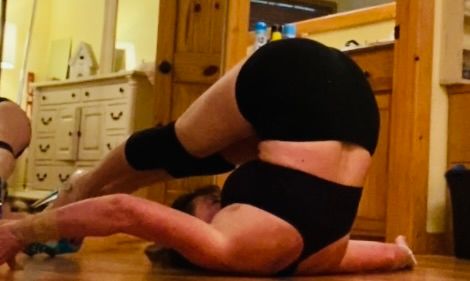
Here is an old pic of me in late 2022. I would almost pass out from this move alone in the warm ups and flexibility classes, just from pressure changes. Spin pole was not even on my radar of a wish list! Can you say ...Ralph when I tried?!
The "Focus Fingers" Reset Button
To conquer the dizzy, you have to master the focus point. We are as unique as snowflakes so each person will HAVE to become attuned to themselves. This is part of dance training called propreception - the ability to know your body, where it is in space and time and how to move it effectively. Your hand is important for the problem...
Before we talk about finding your personal sweet spot, let’s look at a quick trick to emergency-brake your brain outta the Ralph zone using your vision when the dizziness hits.
Note: This is an alternate visualization technique meant for when you are already completely on the ground, but it is highly effective at resetting your dizzy vision once you step off the pole or can think!
Don't close your eyes -squint if you have to. Hang on or SIT DOWN. Do not walk, even though your balance wants to back up or sideways - HANG-ON & immediately...!
Take your hand and place it vertically right between your eyes (yes, like an aggressive, single-horned unicorn).
Stare at your hand. Cross your eyes a little. Embrace the absurdity.
Move your hand straight out about 12 inches, keeping your eyes glued to it.
Pull it back in to your nose. Repeat several times slowly.
Be amazed. Register your instructors voice and get back in there!
What are you doing? You are forcing your eyes and your brain to pause tracking the spinning room and focus entirely on a single, predictable, moving object along a linear track. It forces your gaze inward and interrupts the horizontal sensory blur, signaling to your nervous system that you are back on stable ground.
Hunt For Your Personal Sweet Spot in Motion
Because our bodies, necks, and baseline motion tolerances are wired completely differently, what anchors the inverts & spins for your pole bestie might make you completely miserable. Clinical data shows that sensory adaptation thresholds vary wildly by individual. To survive the spin and pressure changes, you have to find your own brain's custom internal cheat code—because your vestibular system is a unique snowflake that answers to nobody else.
When you are actively on the pole, you have to experiment to find a custom focal zone that works for you: Here are some things to TRY during centrifical moves on the floor or pole:
Looking Up & Outward: Some dancers do best by looking up at the ceiling mount, the top of the pole, or a specific ceiling tile. This can completely bypass the horizontal, high-speed blur of the studio walls for them. Spotting (looking at a fixed place like a ballerina does) works for some, but on the pole at first, this can be hard to do and hard on your neck! AND..., for some of us, looking up or spotting can trigger immediate motion sickness, making it a strategy to entirely avoid.
Looking down at a body part: There are those of us who need to look down to survive. When I am going absolutely hyper-speed into a fast spin, my secret weapon is looking completely inward and downward. I tuck my chin firmly to my chest and lock my eyes dead-center on my own armpit or knee. This works well with the armpit as we open the chest in so many transitions and moves, but it . The knee works best for a tucked position, but your chest will sink causing your chest/back drive to falter or fail. Sometimes starting with the knee then moving to the armpit works well for learning By anchoring my gaze to a part of my own body that is moving with me, the rest of the room completely disappears, giving me a perfectly stable visual frame of reference without triggering a stomach rebellion.
Practice Spin Control: It seems as boring as doing last week's dishes your kid hid in the oven. But it is necessary from the get-go. Use your practice slots for about 2-5 minutes on static pole using your controlled self generated spins for step offs on BOTH SIDES because YOU HAVE 2 EARS! Examples: Step arounds, hooks, carousels with straight legs, Straight climbs and side climbs. Really notice the weight of your sweeping open back leg and your bottom turning rt then left and see where you end up. THEN, do them again(2-5 minutes) on spin pole. Adjust the ANGLE of your fanny, legs and arm reach to slow you down then speed you up. IF one goes great and another is a disaster please talk to your instructor so they can help pin point the problem! Instructors love to help! The more your brain understands, the more control you have, the less times you get to pretend to be an aggressive unicorn!
The Directional Blind Spot: Clockwise vs. Counter-Clockwise
Have you ever noticed that you can spin counter-clockwise all day like a majestic, sparkly wood nymph, but the second you try a clockwise spin, your brain immediately shorts out? If so, this is common.
You need to pay close attention to this specific directional quirk because your vestibular system is split right down the middle. Your left and right inner ears operate as independent sensory teams. Due to structural asymmetries in our bodies, minor head tilt habits, or even just our natural dominance (like being left- or right-handed), one side of your vestibular system is often significantly more sensitive to fluid movement than the other.
Noticing which direction sends you straight into the spatial fog allows you to actively outsmart your biology. It means you can pinpoint your "sensitive ear," deliberately slow down your entry speed on that side, and intentionally give that specific direction a little extra focal love until both halves of your head are playing nice.
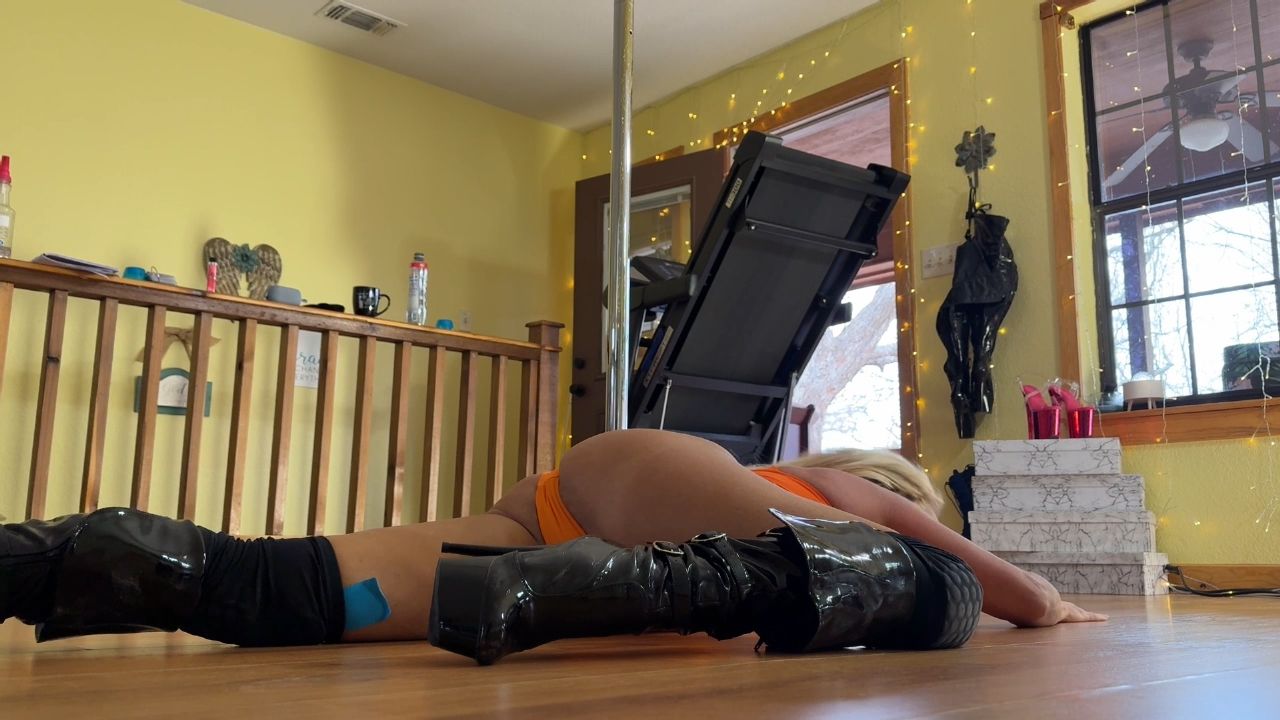 2025 - After 45 minutes of steady inverts & spin pole combinations for competition. I had chugged a ful liter of water, a protien drink and stuffed in a wholewheat bagel. The dizzy got me, I was done. End of practice:foggy, could not remember the next move, Could not find the pole with my leg in a hand stand and it was on my stomach! I get dizzy spinning clockwise more than counter for some reason. I am still working on that "side" she is a stubborn opinionated brain about the issue.
Your Homework This Week
Embrace your own path: Trust your own alignment rather than looking exactly where the person next to you is looking—we are all unique creatures navigating the laws of physics in tiny shorts.
Experiment with your line of sight: Next time you go into a spin, try a completely different focal zone to find what works. If looking up makes you sick, drop your chin, look down, or find your armpit or knee.
Pinpoint the spatial fog: Pay close attention to the exact moment that overwhelming, foggy feeling hits—when you lose track of where you are in space or completely forget your next move. If a specific focus point keeps your head clear and keeps you oriented in the room, you’ve found your winner.
Isolate your directional triggers: Note whether you struggle more going clockwise or counter-clockwise. Track which side makes you go "blank" faster so you can purposefully apply extra visual anchors to your sensitive direction.
Alternate to your weak side: You must switch to your weak side (insert structural, collective, studio-wide groan here) every other run at a sequence. Yes, I know it feels like trying to write your signature with your non-dominant hand while riding a unicycle, but do it anyway!
You need to drink MORE WATER. For the heart and vessels to maintain circulation they need VOLUMN in there! Flat blood vessels means a low amount of blood to the poor conflicted BRAIN who is already confused by the tiny shorts your wearing and the fact your dizzy but have not imbibed a drop of alcohol!
Give that brain some complex carbs to run on, especially before class. The brain runs on carbs. Other nutrients do NOT cross the brain-blood barrier. Pole BURNS up to 450 K/cals per class, up to 600 per hour at upper levels.
Balance your conditioning: Perform all of your off-pole conditioning homework on both sides equally. Your vestibular system has two sides, and if you only train your "good side," your brain will adapt unevenly, leaving you spinning perfectly to the right while turning into a human blender to the left.
In Summary:
The topic this week is hmmm, not falling over or meeting ralph! In looking for examples for social posts this week it was a hoot and they were fun to make . I went a ways back into my early pole years and could see so many times I used these techniques and how hard it was for me personally to suck it- buttercup and keep going. The last in the series is of me on stage at the PSO Level 2 competition. We had to build in "dizzy-recovery" spots for that routine! I would like to thank my private coach that I just watched handle me through about 50 sessions and made sure I was exposed to so many instructors 7 styles.
Much of these practical ideas have come from her and if you every meet Kristen Fritsche you should hug her because she deserves it. She is a great example of polers passing on what they were given and working with individual needs! Love her so much! Dizzy is just part of flying through the air and I didn't even realize how many times I use these techniques until pulling those clips! I hope you all enjoy them as they arrive! In the mean time....
Be patient with your inner ear and your cardiovascular stamina, keep your emergency unicorn hand ready for when you step off, and let's find your individual magic spots!
Empirical & Clinical References
1. Serrador, J. M., Schlegel, T. T., Black, F. O., & Wood, S. J. (2009). "Vestibular effects on cerebral blood flow." BMC Neuroscience, 10(1), 119. This clinical study demonstrates that activating the vestibular balance organs directly impacts cerebral blood flow regulation and systemic blood pressure responses independently of other variables.
2. Rabbitt, R. D. (2019). "Semicircular canal biomechanics in health and disease." Journal of Neurophysiology, 121(3), 732-755. This paper outlines exactly how angular acceleration from head rotation shifts internal inner ear fluid, bending sensory hair bundles to generate motion signaling.
3. Johns, T., & Lawrence, E. (2024). "Evaluation and Treatment of Nausea and Vomiting in Adults." American Family Physician, 109(5), 417-425. This peer-reviewed clinical guide details how vestibular disturbances and the mismatch of tracking data between visual cues and vestibular detection directly trigger motion sickness paths.
Maze | OCT 9, 2026
Share this blog post


© 2026 Mage Flow Pole & Fitness LLC